

Cheung Cho Kwan
Eyeing three girls with heavy makeup and LV bags at the MTR station, Adrian Garcia is convinced some Hong Kong girls have “Princess Syndrome” (gong zhu bing).
According to Menchu Miguelez of the Consul General of Spain, there were 1,298 Spanish nationals registered with the Hong Kong Spanish Consulate as compared to the 1,700 unregistered ones.
She also mentioned that the first Spanish national registered with the Consul General traces back to 1972. Although the economic relationship between Spain and HK have since grown, the more significant change are the cultural exchanges.
The statistics of the Hong Kong Trade Development Council reveal that Hong Kong’s imports from Spain valued at US$ 1.1 billion in 2012, which represents roughly 0.1% of Spain’s GDP, nearly US$1.3 trillion.
Adrian Garcia agrees, “HK is not a big business partner of Spain.”
He had worked as a trade officer of the Hong Kong Spain Chamber of Commerce (HKSCOC) for a year, then resigned last year at his age of 25. Now, he loves Hong Kong and its’ culture.
When asked his opinion about HK girls, the young Spanish laughs softly, “HK girls buy a lot of famous brand bags because they want to show off.”
The Consul General Ms Menchu, who has lived in HK for 12 years, has the same feeling that some HK people are a bit materialistic because they buy expensive brands. “Compared to Europe, it is almost unbelievable how many big LV stores and other high-end brands you find all over HK.”
According to the LV’s official website, Rome, London and Paris, each city only has one specialty store, while HK has two(one in Central and the other in Tsim Sha Tsui).
However, just one girl from Hong Kong attracted Adrian to live here. “I came here for love,” said Adrian. “I originally came here just for an internship, but then I met my girlfriend. Our relationship has flourished despite our different cultures, both of us are tolerant.”
Adrian finds that the HK people he met are not only friendly, but also tolerant. “HK’s tolerant culture could be attributed to a large number of locals going abroad to learn about other countries and their peoples.”
Moreover, HK’s long past as a colonial trading port means that the locals readily engage and interact with foreigners, resulting in tolerance and acceptance of other cultures.
Carlos Valsouto, a 41-year-old Spanish language tutor in HK, has lived here for 6 years. He also notices that most of local girls are concerned with their “beautiful looks” and behave like spoiled princesses, such as being highly demanding to their boyfriends. He believes that 90-95% of local girls have a “Princess Syndrome”.
“Except my girlfriend,” he laughs.

Adrian and Carlos understand that although some of their preconceptions of the city were misleading, their experiences have been exciting as well as fulfilling because they believe that the city and its people are very open, friendly and welcoming. The attitude of HK people has helped them to better adapt to HK culture.
The adaptation to any culture is determined largely by three factors: the friendliness and open-mindedness of the locals, the expectations of the newcomer, and their attitudes towards life.
Adapting to a culture goes hand in hand with promotion of one’s own culture. Some people share their own
culture by meeting friends. When people are proud of their culture or feel homesick, they tend to promote it.
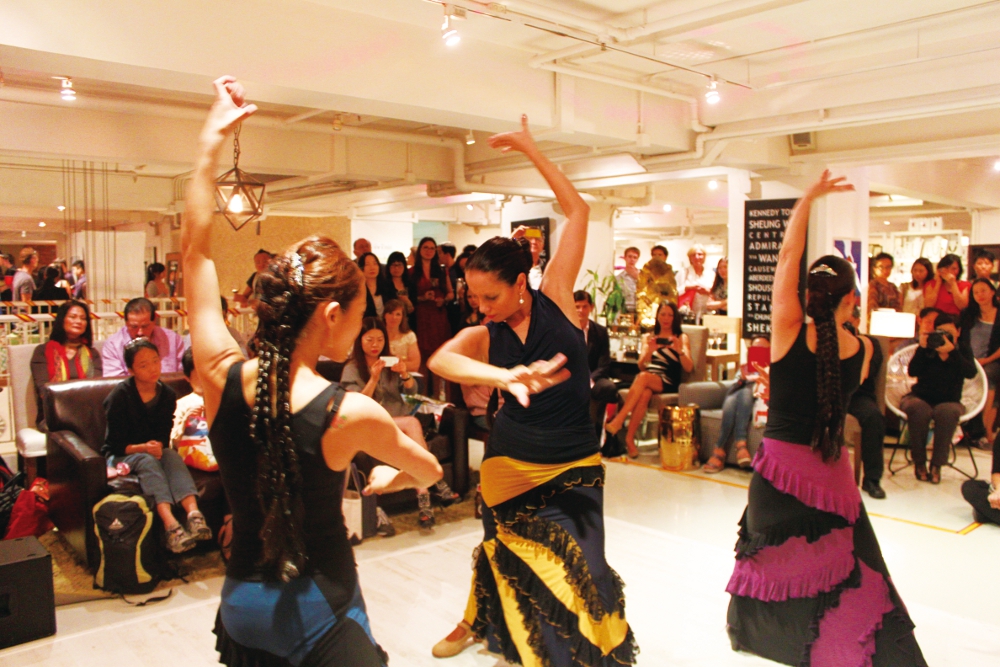
Food, dance and music are common elements in culture around the world. Adrain thinks that there are many good things in Spain worthy for sharing with the people in HK, such as the famous Flamenco dancing and Paella, the fried rice with seafood.
He promotes Spanish culture by organizing Spanish events, such as the “Sensationally Spain” held in Central from October 23 to 25. These large public events are only possible with the help of sponsors, such as the HKSCOC and the Consulate of Spain in HK.
Most countries in the world have well-known customs. For example, Thailand is known for the Songkran Festival (during which people splash water on others symbolically to wash bad things away), while Venice has its Mask Festival (wearing exaggerated masks and gorgeous vintage attire) and Spain has bullfighting.
Some long-standing cultural symbols have become controversial nowadays, such as the bullfighting has even been forbidden in Catalonia of Spain since 2012.
“I personally don’t like to promote it,” says Menchu.

