

Once the world’s busiest port, Hong Kong has seen its global ranking in container throughput dropping to fifth in 2015, a 13-year low, behind Shanghai and its two mainland sibling rivals and Singapore.
Christy Lo reports
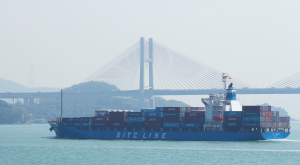
With 340 ships sailing to 470 global ports each week, the billion dollar question remains: can Hong Kong return to its golden days with the national “Belt and Road” initiative?
Professor Thomas Chan Man Hung, Director of the Belt and Road. Research Institute of Chu Hai College of Higher Education and Hong Kong’s renowned economist, expressed his worry to our reporter earlier about the future of Hong Kong marine industry.
“In recent years, the source of goods has been mainly coming from Pearl River Delta (PRD), and the scale of container terminals along PRD is much greater than those in Hong Kong, which means most problems that Hong Kong marine industry facing is generally a lack of competitiveness,” Chan explained.
He said, this phenomenon could be traced back to the time before Hong Kong reunification. The colonial government was not willing to invest on marine industry for long-term development. Even after 1997, the HKSAR government did not introduce any significant strategy to enhance the industry’s competitiveness and thus led to a gloomy future.
But the Belt and Road Initiative, initiated by China’s president Xi Jinping in 2013, aims for economic development among emerging countries. The 21st- Century Maritime Silk Road will have a significant impact on the marine industry of Hong Kong.
However, Chan pointed out the strategic focus, based on the current development, mainly centers on Silk Road Economic Belt. In other words, the focus is on land transport across continents.
“This is a concern – if the 21st – Century Maritime Silk Road is not developing well, particularly because of the risk of Strait of Malacca (e.g. coming across pirates and military conflicts), this may cause negative impacts to the whole Chinese marine industry,” he said.
“Furthermore, there is political conflict on the South China Sea seaway, hence the way from Hong Kong to Indian Ocean is risky.”
According to information from Hong Kong Maritime and Port Board, Hong Kong has nine container terminals with 24 berths. As the annual throughput dropped consecutively in recent years, Hong Kong government has suspended to develop the tenth container terminal.
As the world’s 8th largest trading economy, Hong Kong’s export by sea transport now accounts for 18.5% per cent of the overall export.
Prof. Chan believed sea transport is not as attractive as rail transport, and the latter is the largest challenge of Hong Kong marine industry currently facing.
“Many cities in Mainland China have railways to transport freights to Europe, Central Asia and other places,” he said.
“In other words, most of the manufacturers and traders would choose railways due to less time-consuming, for example, it takes only 10.5 days from Chengdu to Europe, while sea transport takes 40 to 50 days.
“As the Silk Road Economic Belt develops efficiently in Mainland China, people could consider using railway rather than sea transport.”
Since the launch of the China-Europe Railway Express (CR Express) linking China with Europe by fast-track cargo rail, freight volume has increased substantially.
According to China Railway Corporation, the CR Express provides regular rail services to at least 16 Chinese cities, calling at more than 12 cities in eight European countries currently.
Prof. Chan said Dongguan has already opened up the China-Europe Express Train, as well as Guangzhou. But Hong Kong is not included.
The Belt and Road Initiative includes two south routes from China, and six international economic co-operation corridors such as Bangladesh-China-India-Myanmar Economic Corridor.
“Lots of freights were transported by rail from China to Central Asia, and then via Pakistan to Indian Ocean. When Myanmar’s railway will be opened up, people could transport freights from Yunnan province to Myanmar, and then to Indian Ocean,” he said.
Hong Kong may face the additional challenge of marginalization if cargo ships will not pass through Strait of Malacca or South China Sea, and the marine industry may continue to decline in the future.

