

・Hong Kong would have to bite the bullet.
・The restoration of HOC is a public good.
・It may be called a housing mess.
・The deep-seated conflict lies in the gap between the rich and the poor.
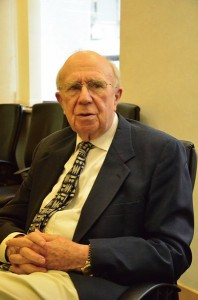
Our reporters interviewed with Sir. David November 16, talking about some issues such as housing policy, New Territories Small House, and the deep-seated conflict mentioned by Chinese Premier Wen Jia-bao. Below is the excerpt edited from the transcript of the tapes.
By: Ip Chi Wai Danny, Wong Man Ying, Ng Kin Pong,
Cheng Wing Yi, Yeung Pui Wan
R: The reporter
D: Sir. David Akers-Jones
R: You arrived in Hong Kong in 1957, and have experienced many events here since then such as the handover in 1997. Apart from the handover, what changes in HK society have impressed you?
D: I suppose the biggest change is the population growth. In 1945, when the Japanese left, the population was about 600 thousand people. By 1955, it was nearly 2 million people. And since that period, the population every ten years has grown by 1 million people, and now 7 million people.
And then the second biggest change is to house all these people starting from 1945. How to house 2 million people here in the ten years from 1945? Where did they be housed? Now, What happened was that they built houses for themselves. Houses are made of tin, wood, anything likely to build Squatter House, all over the hillsides. And apart from building squatter houses, they crowded into the existing houses in Hong Kong, the existing buildings of Kowloon. So, in Sham Tsui Po, Tai Kwok Tsui, Mong Kok, everywhere. They crowded into the existing houses and divided them into small flats. So, these two things are the biggest changes, population growth and housing.
And then, the next biggest change is really what these people were going to do when they came to Hong Kong? Many of them worked in factories in China, and the owners of those factories in the mainland also came to Hong Kong with money and machinery, and they started up factories in Hong Kong to give employment to the people. So, the economy of Hong Kong changed from being a trading place of import and export, and became an industrialized city. So, that is another big change, the change in economy.
But then, the government had started a housing programme in 1954, started building resettlement housing to 1974. And then there was a change of governor in 1971, he (Sir. Murray MacLehose) decided that although we had had a housing programme, it wasn’t enough, so he decided to start a ten-year housing programme. In order to do this, we would build new towns in Sha Tin, Tai Po, Fan Ling, Shang Shui, Yuen Long, and Tuen Mun, and continue expanding the new town at Tsuen Wan to Kwai Chung, to Tsing Yi, and later on to Cheung Kwan O. So, we did that. From 1973 to 1985, we had built approximately 1 million homes for people in the new towns in the New Territories. So that is a big change.
The time after we finishing the ten-year housing programme, the economy of Hong Kong began to change again. The work by the people lived in those houses in new towns began to move to the mainland and Guangdong. From then on, the gap between the lower paid people in the population and the rich in middle class began to widen. So now we have a serious situation of a gap between the rich and the poor. Very serious situation and it is not easy to solve that problem, because it’s very difficult to turn the clock back and to start manufacturing all over again. Especially since then, the mainland has been producing all the things we used to produce.
R: Hong Kong has been named as “the Pearl of the Orient” before the handover. Could you sum up the reason of the success made by the colonial government?
D: Do you think it was a success? Well, right from the beginning, Hong Kong had a legal system and the independent judiciary. So the law was the basis of Hong Kong. It’s very important that’s common law, and another important factor here was freedom. This system attracted people to invest in Hong Kong, they knew the system was based on common law, and they knew their investments would be protected by the law, and the taxation was low. They built and built here. Hong Kong was built by the people themselves. And the government just tried to do what the people need, in other words, to build the roads, to build the water supply, provide housing, and so on.
R: We know that you participated in making the New Territories Small House policy. Now, does the problem of unauthorized building work violate the original purpose of the policy? And how can be the problem solved?
D: The spirit of providing the policy is to enable the village people to build homes for themselves. It is quite a good one. Because no specific policy to allow them to do that before. But the policy didn’t be worked out carefully and not clearly enough, not say precisely. People could use the policy and abuse the policy. Not only provide housing for themselves, but a form of investment, and a form to get rich. When it was introduced, it was to provide public housing, but now provides much more, provides an investment opportunity.
Unfortunately, as the secretary of the development said the other day, it is an extreme difficult to stop it, because the villagers have children, and then their children have children. You know, you can’t see the end anywhere. It last forever, but the land doesn’t last forever. It is the problem now, because the villagers complain they haven’t enough land to supply the demand. The government has a dilemma, so it is an extreme problem.
The answer is not to allow them to build the houses high, which has been suggested by some person to build five-story or six-story, nine-story. That won’t solve the problem, and just make the situation worse.
I can tell you I can talk for hours about this small house policy. It is a very difficult problem. And it would probably cost billions to solve the problem, but I think Hong Kong would have to bite the bullet. To bite the bullet means to make a hard decision to find the solution, and the solution would be expensive.
We would have to compensate the villagers for their lost with the small house policy. It needs to compensate all the children of the villagers, or compensate the man for their privileges. It has to reach a bargain between Heung Yee Kuk ( 鄉 議 局 ) and the government, and it would be expensive. But it would be worthwhile because it will solve a political problem.
Also, I think we have to look in another way. In 2010, 3,000 village houses were built. Each house consists of three floors. So, we get 9,000 flats. Do you know how many flats were built by the private sector last year? The private sector only built 8,000 flats.
R: But very few people know about that.
D: Yes, you come to the right source for information.
R: Some people believe that the restoration of the subsidized Home Ownership Scheme (HOS)would affect the property market. Could you express your opinion?
D: I think you have to decide this in a much more comprehensive way than just good or bad. People to have housing, shelter and food to eat, and hopefully work to do. This should be the aim of government really, and it is something called the public good. It’s not the government good, it’s the public good.
Now, in recent years, we have fallen behind in providing housing for the public good. So, we have to come to the question how we are going to do this.
We have to devise policies either whereby the private sector will provide sufficient homes for people or the government will step in and do it itself. We stopped(HOS) in 2002, and turn to the present policy. We have used this policy for the last 10 years since 2002, but it hasn’t worked. It could not provide enough homes, and the house got more and more expensive. The rate of building didn’t match the rate of demand, and the house became more expensive, so it may be called a housing mess.
We have got to solve this housing mess. What is the public good? Well, building homes of home ownership scheme again would be the public good. It must do something to meet the public good. Would it do harm? You have to look, have to see whether the provision of housing for those people who have no good housing would hurt the people who already have the housing.
My belief is, it does not do so. People who buy these flats, do not have enough money to buy a flat in the private sector, so they are not in a competition with people who are buying flats in the private sector. There is no competition at all, all it does are to reduce the pressure of the private sector to go on providing with flats on demand.
R: Chinese Premier Wen Jia-bao claimed that Hong Kong should solve the deep-seated conflict. Do you think the conflict is based on politics, or related to economy?
D: I think it’s the widening gap between the rich and the poor, the rich getting richer and the poor getting poorer. That is the basis for the conflict. Some people are greedy, they love getting richer. One of the good thing about the present situation in Hong Kong is about half the people have public housing, a quarter own their own homes, the private homes. There is another group, about a quarter, roughly speaking, who are living below the satisfactory accommodation, and we have got to provide homes for them.
There are more freedom in Hong Kong than Singapore to do anything, but Singapore has started the housing policy 50 years ago, even before the People’s Action Party came to power. Pursuing a policy and providing homes for people, public homes and schools, all those things made the public good.
Sir David Akers-Jones
1927: Born in Sussex, England on 14 April.
1957: Arrived in Hong Kong as colonial official of the government.
1985-1987: Chief Secretary of HK.
1986-1987: Acting Governor of HK.
1987-1992: Chairman of HK Housing Authority.
1993-1997: Adviser on HK Issues to Government of PRC.

